Starting a taxi or ride-hailing business in Latin America in 2026 is more accessible than most founders expect. You do not need to buy a large fleet, rent an office, or develop custom apps from scratch. A lean, local taxi startup in Mexico, Colombia, Brazil, Argentina, or Chile can launch with a few reliable drivers, driver-owned vehicles, and ready-made dispatch software — for a fraction of what it would have cost five years ago.
Why Latin America is a strong market for new taxi and ride-hailing startups
More than 80% of Latin America's population lives in urban areas. Passengers in major cities are already familiar with app-based booking, and digital ride-hailing is mainstream across Brazil, Mexico, Colombia, and beyond.
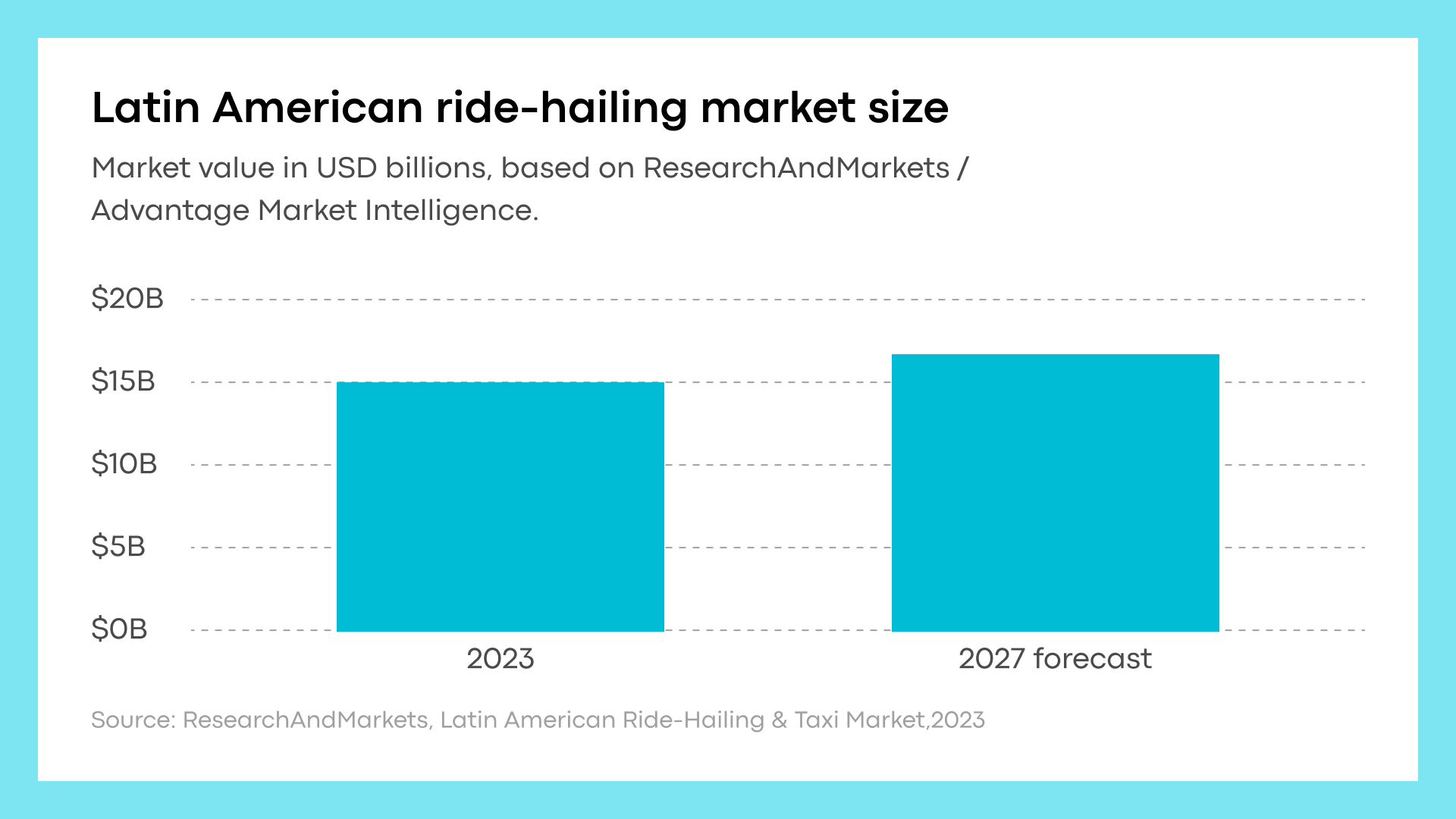
Latin America's taxi and ride-hailing market is one of the fastest-growing in the world. According to ResearchAndMarkets, the Latin American ride-hailing market was valued at $15.1 billion in 2023 and is projected to reach $16.4 billion by 2027. Brazil, Mexico, and Colombia remain among the key markets shaping ride-hailing growth in the region.
Despite that scale, large platforms do not serve every market well. Local operators still find real opportunity in smaller cities, airport and hotel transfers, corporate transport, and communities where global apps provide inconsistent coverage or poor driver supply.
The competitive landscape includes Uber, DiDi, inDrive, 99 (Brazil), and Cabify (in selected markets). A relevant signal: in 2026, inDrive stated that Latin America still represented slightly more than half of its global business — confirming that passenger demand for alternative ride-hailing models remains strong across the region.
How much does it cost to start a taxi business in Latin America?
This is the most common question from founders researching the space — and the answer depends heavily on your country, city, operating model, and fleet size.
As a rough guide, a lean LATAM taxi startup can get operational with a budget between $500 and $5,000 depending on the following variables:
| Cost category | Low estimate | Higher estimate | Notes |
|---|---|---|---|
| Business registration | $50 | $400 | Varies significantly by country |
| Driver and vehicle permits | $100 | $800 | Per driver/vehicle; varies by city |
| Commercial insurance | $200 | $1,500/year | Required in most markets |
| Dispatch software | $12/month | $100+/month | Ready-made platforms vs. white-label |
| Marketing and customer acquisition | $100 | $1,000+ | Social media, local ads, referrals |
| Working capital (driver floats, cash ops) | $100 | $500 | Depends on cash payment volume |
What you don’t need to spend money on at launch:
- Buying a fleet (start with driver-owned vehicles)
- Building custom passenger or driver apps (use ready-made platforms)
- Renting an office (dispatch software runs from a laptop or phone)
- Hiring a technical team (modern taxi software requires no coding)
What to know before launching in each LATAM market
Latin America is not one single taxi market. Payment habits, driver requirements, legal rules, and passenger behavior vary by country and even by city. Use the table below as a starting point, then confirm the exact transport, insurance, and business requirements in your launch city.
| Country | Market snapshot | Best launch approach | Payments and booking habits | Legal and operational checks |
|---|---|---|---|---|
| Mexico | • Ride-hailing market size in 2025: $3.86B • In-app / online booking share: 85.3% • Cash share of market value: 52.9% | • Start with one regional city, airport route, tourism area, or underserved neighborhood • The opportunity is in combining digital booking with cash payments | • Cash-trip management is essential • Driver balance tracking is needed for reconciliation • OXXO payments may be useful for top-ups or subscription billing • WhatsApp booking links can work well | • Local permits vary by municipality • Mexico City taxi drivers may need a Tipo B licence • Commercial passenger insurance and vehicle requirements should be confirmed before launch |
| Brazil | • Largest ride-hailing market in Latin America by volume • Internet users in 2025: approx. 183M • Uber users: approx. 30M • Registered Uber drivers and couriers: approx. 1.4M |
|
|
|
| Venezuela | • Internet users in 2025: approx. 17.5M • Internet penetration: approx. 61.6% • Main local competitors: Yummy Rides and Ridery | • Avoid competing broadly from day one • Focus on one city, route, or passenger niche where existing services are inconsistent | • Confirm local payment habits in the target city • Cash support may be important depending on the segment | • Verify local vehicle, driver, insurance, and transport requirements before accepting paid rides |
| Colombia | • Strong urban demand • Major cities can be complex because ride-hailing is heavily regulated | • Good opportunities: airport transfers, city corridors, regional routes, and local transport niches | • Cash and digital payments both matter • Nequi and Daviplata are important local options • Card terminals may also be relevant | • Check whether the business model and platform support compliance documentation • Requirements may include Cámara de Comercio registration, Tarjeta de Operación, SOAT insurance, technical inspection, and the correct driver licence category |
| Argentina | • Internet users in 2025: approx. 40M • Internet penetration: approx. 88% • Main markets: Buenos Aires, Córdoba, Rosario | • High internet penetration, but strong price sensitivity • Regional markets may be easier to test than highly competitive major cities | • Cash remains dominant • Mercado Pago may be relevant for digital payments • Flexible pricing is important | • Economic volatility makes fixed USD-denominated subscriptions harder to manage • Prefer platforms with flexible billing • Confirm provincial and municipal transport requirements |
| Chile | • Internet penetration: approx. 90% • Main opportunities: Santiago, Valparaíso, Concepción, Antofagasta | • One of the region’s more digitally mature markets • Passengers expect a reliable booking experience from the beginning• Regional cities may be easier to enter than Santiago | • Cash is still used, especially outside major city centers • Webpay and Khipu may be relevant local payment options | • Confirm whether the business falls under regulated taxi rules or platform-transport rules • Insurance, vehicle condition rules, and municipal requirements should be checked before launch |
| Peru and Ecuador | • Strong smartphone penetration supports app-based bookings • Larger cities and regional corridors may offer good launch opportunities | • Good starting points: airport transfers, underserved zones, regional routes, and city-specific niches | • Cash is still widely used outside major city centers • Local digital payment habits should be validated before adding integrations | • Driver, vehicle, insurance, and platform rules vary locally • City-level requirements should be checked before accepting paid rides |
How to start a taxi business in Latin America: step by step
Step 1: Pick one city and one niche
Start with a single city, a specific airport route, a commuter area, a tourism zone, or an underserved neighborhood — not an entire metropolitan area.
The best early markets usually have:
- Concentrated, predictable passenger demand
- Limited or inconsistent vehicle coverage from existing platforms
- A clear passenger segment (tourists, commuters, corporate travelers, hotel guests)
- Drivers who are dissatisfied with existing platform earnings or conditions
- Routes where passengers value reliability over the lowest possible fare
A narrow launch makes it easier to control pickup times, driver availability, service quality, and marketing spend. Proving the model in one niche is more valuable than spreading thinly across a whole city.
Step 2: Start with a small driver base
You do not need a large fleet to validate whether the business works.
A realistic starting point:
- Your own vehicle as an owner-driver
- Two to five independent drivers who already own suitable vehicles
- An existing taxi company that needs a digital booking channel
Buying a large fleet before validating demand creates unnecessary financial risk. Fleet size is rarely the early bottleneck — driver availability when passengers request rides is.
Three dependable drivers who consistently accept orders are more valuable than twenty registered drivers who are rarely online.
Before launching, define in writing:
- Who pays for fuel and maintenance
- How fares are calculated
- What commission or service fee applies to each trip
- How cash rides are recorded and settled
- How and when drivers receive payouts
- What happens when an order is cancelled
- What service standards drivers must follow
Clear terms at the start prevent the disputes that cause early-stage taxi businesses to stall.
Step 3: Set up your dispatch system before you need it
This is where many new operators make their first serious mistake.
Handling taxi orders through calls, WhatsApp chats, or spreadsheets may work for the first handful of rides. After that, manual processes create:
- Lost or duplicated orders
- Dispatch delays
- Poor visibility into active drivers
- Confusion about completed and cancelled trips
- Inaccurate fare records
- Difficulties managing cash payments
- A service experience that passengers do not trust or return to
You need a digital dispatch system before you reach the point where manual management breaks down.
Building passenger and driver apps from scratch can require $30,000–$100,000 or more in development costs, a technical team, and months of work. For a new operator, ready-made taxi booking software is significantly lower risk and lower cost.
A good dispatch platform handles booking, driver assignment, trip management, cash operations, and reporting from one place. It gives you visibility into completed rides, cancellations, driver activity, cash balances, and business performance from day one.
Step 4: Support the payment methods your passengers already use
Cash support is essential in most LATAM markets. The Mexico data illustrates why: 85.3% of ride-hailing bookings are made digitally, but cash still represents 52.9% of the market's value. Operators that accept only digital payments exclude a significant share of passengers.
Accepting cash requires more than allowing a driver to collect it. You also need a process for:
- Recording completed cash rides in your dispatch system
- Calculating the company's commission on each trip
- Tracking what each driver owes in cash
- Reconciling driver balances regularly
- Handling cancelled or disputed cash orders
Beyond cash, consider the payment methods relevant to your specific market:
| Market | Relevant payment methods |
|---|---|
| Mexico | Cash, card terminals, OXXO, digital wallets |
| Brazil | Cash, PIX, card terminals, digital wallets |
| Colombia | Cash, Nequi, Daviplata, card terminals |
| Argentina | Cash, Mercado Pago, card terminals |
| Chile | Cash, Webpay, Khipu, card terminals |
Do not add every payment method at launch. Start with cash and one digital option. Add more once the operation is stable.
Step 5: Handle the legal requirements for your specific city
Transport regulations in Latin America vary between countries, states, provinces, and municipalities. The correct approach depends on whether you operate as a traditional taxi company, a private-hire transport provider, a ride-hailing platform, a dispatch service, or an airport transfer business.
The following is a general overview. Confirm all requirements with the relevant transport authority or a qualified legal adviser in your city before starting commercial operations.

Recommended tools for launching a taxi business in Latin America
Taxi dispatch software: Onde.Light
For a new taxi operator in Latin America, Onde.Light is one of the most accessible platforms to start with.
It includes a Driver app, Passenger Web booking panel (passengers book through a browser without downloading an app), an Operator panel for creating and managing orders, automated dispatch, cash-trip management, driver balance tracking, and business analytics.
Plans start at $12 per month with no setup fee. The first 1,000 completed rides per month are included without commission. A 1.9% commission applies beyond that threshold.
This pricing structure means costs grow in proportion to revenue — a meaningful advantage for a startup still building demand. A founder launching in Guadalajara, Medellín, or Santiago can run a fully operational dispatch system for less than the cost of a single tank of fuel per month.
Onde.Light supports Spanish and Portuguese interfaces, making it suitable for driver and operator adoption across the region.
FAQ
How much does it cost to start a taxi business in Latin America?
A lean LATAM taxi startup can get operational for between $500 and $5,000 depending on country, city, fleet size, and operating model. The main cost categories are business registration, driver and vehicle permits, commercial insurance, and dispatch software. Using ready-made dispatch software (from $12/month) instead of building custom apps eliminates what was previously the largest startup cost.
How do I start a taxi business in Mexico City?
In Mexico City, start by registering your business with SAT (RFC), obtaining the correct municipal transport permit, ensuring drivers hold a Tipo B licence, and securing commercial passenger insurance for each vehicle. Use ready-made dispatch software to manage bookings and driver assignments from day one. Focus initially on one corridor or zone rather than the entire city.
Can I start a taxi company with just one car?
Yes. Many operators begin as owner-drivers with a single properly registered and insured vehicle, then add drivers after validating passenger demand. The practical limitation is availability: a one-car operation cannot accept overlapping orders or maintain coverage when the vehicle is unavailable.
How many drivers do I need to start a taxi business?
A local taxi business can begin with two to five reliable drivers in a defined service area. Driver activity matters more than total registrations. Three drivers who consistently accept orders provide better service than twenty who are rarely online.
How do I compete with Uber and DiDi in Latin America?
Do not try to out-scale Uber directly. Compete on the dimensions large platforms cannot easily match: local knowledge, cash payments, better driver relationships, reliability in specific corridors, pre-booked and corporate transport, and direct customer communication.
Do I need to build my own taxi app to start a taxi business?
Yes. You do not need to develop custom apps from scratch to start operating. There are ready-made taxi platforms that you can start using almost immediately. They usually include the core tools a taxi business needs: a Driver app, online booking for passengers, an Operator panel for managing orders, and admin tools to control trips, drivers, payments, and business performance.
For example, Onde.Light lets you launch a taxi service in one day, with plans starting from $12/month. It includes a Driver app, Passenger Web booking, an Operator panel, automated dispatch, cash-trip management, driver balance tracking, and business analytics.
What is the best low-cost taxi dispatch software for a startup in Latin America?
The best option depends on fleet size, booking channels, and monthly trip volume. For most LATAM startups, Onde.Light is the strongest starting point: $12/month with no setup fee, Spanish and Portuguese interfaces, cash management, Passenger Web booking, and the ability to handle phone orders.
This article is based on publicly available information, company websites, product documentation, market reports, user reviews, and platform data reviewed in July 2026.
Sources:
https://www.un.org/en/desa/68-world-population-projected-live-urban-areas-2050-says-un
https://www.businesswire.com/news/home/20240108096524/en/Latin-American-Ride-Hailing-Taxi-Market-Report-2023-Exploring-the-Evolution-of-Contemporary-Business-Models---Forecast-to-2027---ResearchAndMarkets.com
https://www.statista.com/outlook/mmo/shared-mobility/ride-hailing/latam
https://www.reuters.com/world/asia-pacific/ride-hailing-app-indrive-says-revenue-up-31-2025-eyes-delivery-expansion-2026-03-16/
https://clutch.co/topdesignfirms/app-development/blog/app-development-cost-breakdown
https://www.mordorintelligence.com/industry-reports/mexico-ride-hailing-market
https://datareportal.com/reports/digital-2025-mexico
https://www.sat.gob.mx/portal/public/tramites/inscripcion-al-rfc-pm
https://www.semovi.cdmx.gob.mx/tramites-y-servicios/taxis
https://www.semovi.cdmx.gob.mx/tramites-y-servicios/taxis/expedicion-renovacion-o-reposicion-de-licencia-tipo-b-para-operador-de-taxi
https://www.oxxo.com/oxxo-pay
https://www.oxxo.com/oxxo-pay/negocios
https://datareportal.com/reports/digital-2025-brazil
https://www.reuters.com/world/china/uber-ifood-announce-strategic-partnership-brazil-2025-05-14/
https://www.gov.br/empresas-e-negocios/pt-br/redesim/abrir-cnpj
https://www.gov.br/dnit/pt-br/assuntos/noticias/dnit-alerta-condutores-que-exercem-atividade-remunerada-ao-volante
https://www.planalto.gov.br/ccivil_03/_ato2015-2018/2018/lei/l13640.htm
https://www.planalto.gov.br/ccivil_03/_ato2011-2014/2012/lei/l12587.htm
https://www.bcb.gov.br/estabilidadefinanceira/pix-em-numeros-estatisticas
https://www.bcb.gov.br/detalhenoticia/21079/nota
https://datareportal.com/reports/digital-2025-colombia
https://mintransporte.gov.co/descargar.php?idFile=13043
https://mintransporte.gov.co/info/mintransporte/media/anexos/14M1jaaO.pdf
https://mintransporte.gov.co/loader.php?id=30333&lFuncion=visorpdf&lServicio=Tools2&lTipo=descargas&pdf=1
https://www.ventanillamovilidad.com.co/tramites/expedicion-tarjeta-de-operacion
https://www.ventanillamovilidad.com.co/tramites/renovacion-de-tarjeta-de-operacion